Lost in Lahore: The Skyline Secrets No One Talks About
You know that feeling when a city surprises you? Lahore did that to me. Beyond the bustling bazaars and historic forts, I stumbled upon quiet rooftops, hidden terraces, and silent vantage points where the soul of the city unfolds in silence. These aren’t tourist spots — they’re local escapes. And from up high, Lahore reveals a beauty no guidebook prepares you for. It’s not in the grand arches or the spice-scented alleys, but in the hush between minaret calls and the flicker of dusk settling over clay-tiled roofs. This is a different kind of discovery — one that asks not for a map, but for stillness, curiosity, and the courage to look up.
The Pulse of Lahore: More Than Just History and Heat
Lahore pulses with a rhythm all its own. To many, it is synonymous with the grandeur of the Badshahi Mosque, the labyrinthine charm of the Walled City, and the sizzle of Food Street after dark. These landmarks are undeniably iconic, each a testament to centuries of cultural richness, Mughal artistry, and Punjabi warmth. Yet, for all their splendor, they represent only one layer of the city’s identity — the one most easily captured in photographs and shared online. What often goes unnoticed is the quieter, more intimate Lahore: the Lahore that breathes in the spaces between honking rickshaws, in the rustle of laundry strung across narrow lanes, and in the soft glow of kerosene lamps on rooftops as evening falls.
This hidden dimension becomes most visible when seen from above. From an elevated vantage, the city transforms from a collection of monuments into a living tapestry of daily life. The scale shifts. The noise recedes. What remains is a sense of continuity — the unbroken thread of routine, ritual, and resilience that defines urban existence here. A child kicking a football on a flat roof, a grandmother stirring lentils over a gas flame, the distant hum of a generator kicking in — these are the moments that, when viewed from height, coalesce into a deeper understanding of Lahore’s soul.
Elevation does more than offer a better view; it changes how we perceive a place. On the ground, we navigate through sensory overload — the press of crowds, the aroma of fried samosas, the call to prayer echoing through congested lanes. But above it all, perspective widens. We begin to see patterns — the geometry of rooftops, the flow of traffic like blood through veins, the way light moves across neighborhoods as the day progresses. This is not tourism as checklist, but as contemplation. And in Lahore, where history and modernity collide in vibrant chaos, such moments of clarity are rare — and deeply valuable.
Why Viewpoints? The Quiet Power of Looking Down
There is something inherently grounding about looking down on a city. It is not an act of superiority, but of surrender — a willingness to pause, to absorb, to let the world unfold beneath you without the need to participate. In an age where travel is often measured by how much we do, the simple act of watching becomes revolutionary. Elevated spaces invite stillness. They offer a rare reprieve from the constant motion of urban life, allowing travelers to witness the city not as a series of destinations, but as a continuous, breathing entity.
Psychologically, height alters perception. Studies in environmental psychology suggest that elevated viewpoints can reduce stress and enhance feelings of awe and connectedness. When we rise above the street level, our brains process information differently. Details blur, and broader patterns emerge. We see how neighborhoods connect, how light spreads like water across rooftops at sunset, how life persists in the smallest corners. In Lahore, where the urban fabric is dense and layered, this shift in scale is especially powerful. From above, the city’s chaos resolves into rhythm. The honking fades into background hum. What remains is a sense of order within the apparent disorder — a harmony that is felt more than heard.
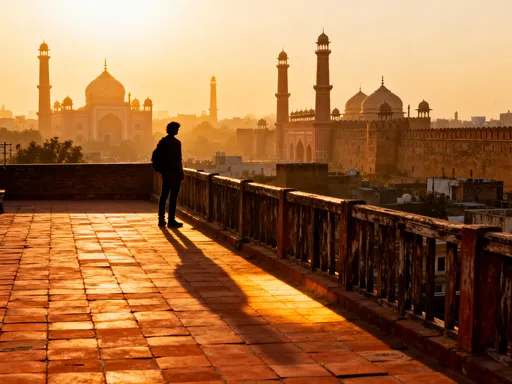
Consider the moment just before dawn, when the first light creeps over the minarets of the Badshahi Mosque. From a quiet rooftop, the city is still half-asleep. The air is cool. The sky shifts from indigo to soft gold. Then, the first call to prayer rises — clear, resonant, unhurried. From this height, the sound doesn’t compete with traffic; it floats, wrapping around the city like a blessing. These are not experiences designed for tourists. They are not staged or scheduled. They are real, fleeting, and available only to those who take the time to rise above the noise — both literal and metaphorical.
The emotional reward of such moments is profound. They offer clarity, not through answers, but through presence. You are not chasing a sight; you are allowing it to come to you. This is the quiet power of looking down — not to dominate the view, but to be humbled by it. In Lahore, where the pace of life can feel relentless, these elevated pauses become acts of resistance against the rush, invitations to see more deeply, feel more fully, and remember that travel is not just about moving through space, but about being present in it.
Finding the Unseen: How We Miss What’s Above Us
It’s easy to overlook the skyward dimension of any city. Our eyes are trained downward — to watch our steps, read signs, avoid traffic. Even in travel, we focus on what is at eye level: facades, storefronts, street performers. The rooftops above remain invisible, not because they are hidden, but because we do not think to look. In Lahore, this tendency is amplified by cultural norms. Many rooftops are private spaces — extensions of homes, places for family gatherings, afternoon naps, or evening prayers. They are not public attractions. There are no ticket counters, no guided tours, no Instagrammable signage. Their very inaccessibility makes them more authentic, more intimate.
Yet, this secrecy is also what makes discovery so rewarding. The best viewpoints in Lahore are not found through search engines or travel apps. They are discovered through conversation, through kindness, through the willingness to stray from the planned route. A friendly shopkeeper might gesture toward a narrow staircase behind his store. A neighbor might invite you up after noticing your curiosity. An open door at the back of an old haveli might reveal a winding stair leading to a sunlit terrace. These moments are not guaranteed, but they are possible — and they depend on human connection more than navigation skills.
The architecture of Lahore also plays a role in hiding its heights. Many buildings in the Walled City are centuries old, their upper levels obscured by overhanging balconies, intricate jharokhas, and climbing vines. From the street, it’s difficult to tell how many stories a structure has, or whether its roof is accessible. Modern buildings in areas like Gulberg or Defence are more visible, but their rooftops are often gated, reserved for residents. The result is a city whose skyline is felt more than seen — a secret known only to those who live within it.
But the clues are there for those who pay attention. A ladder leaning against a wall. A rooftop garden spilling over the edge with potted plants. The sound of laughter from above. These are invitations, subtle and unspoken. They ask only that we look up, that we slow down, that we approach not as conquerors of sights, but as quiet observers. In doing so, we move beyond the role of tourist and become temporary guests in the lives of others — a shift that transforms not just how we see the city, but how we are changed by it.
A Walk Through the Hidden Heights: Three True Vantage Points
Not all elevated views in Lahore require special access or connections, though some do. There are a few authentic, non-commercial vantage points that, while not widely advertised, are accessible to respectful visitors who approach with humility and patience. These are not rooftop bars or luxury hotels with panoramic terraces. They are modest, unassuming places where the view is not the only attraction — the atmosphere, the stillness, the sense of being somewhere real is equally important.
One such place is a small rooftop café tucked away in a quieter part of Gulberg. Unmarked and family-run, it opens in the late afternoon and stays open until just after sunset. The seating is simple — plastic chairs, wooden tables, a faded awning for shade. But the view is extraordinary. To the west, the Minar-e-Pakistan stands silhouetted against the evening sky, its white marble glowing as the sun dips below the horizon. As the city lights begin to flicker on, the surrounding neighborhoods — Aziz Bhatti Park, Iqbal Town — spread out like a grid of golden threads. The air carries the scent of roasted corn from a nearby vendor and the occasional breeze from the canal. This is not a place for loud conversations or group photos. It is a space for quiet reflection, for watching the day end with dignity.
Another remarkable viewpoint is found within the Walled City, in a restored haveli that now functions as a cultural guesthouse. The building itself is a piece of living history — its walls adorned with frescoes, its courtyard lined with arched walkways. But the real treasure is the rooftop terrace, reached by a narrow, hand-carved staircase. From here, the Lahore Fort appears not as a distant monument, but as a neighbor — its red sandstone walls rising just beyond the sea of terracotta roofs. On clear evenings, the reflection of the fort’s illumination can be seen in the pool below. Families gather here in the cooler hours, sipping tea, playing cards, or simply sitting in companionable silence. Visitors are welcome, but expected to respect the space — to speak softly, to remove shoes if asked, to appreciate the moment without demanding it.
A third, lesser-known overlook is located near the Canal Bank area, just past the tree-lined walkway popular with joggers and strollers. A small public park on a slight elevation offers an unobstructed view eastward, where the skyline blends old and new — historic domes alongside modern apartment blocks. What makes this spot special is not just the view, but the rhythm of life around it. Elderly men play chess under neem trees. Children chase pigeons. Couples walk hand in hand along the water’s edge. From this height, the canal becomes a silver ribbon winding through the city, reflecting the sky in shifting patterns. It is a democratic space — open to all, free of charge, uncommercialized. Few tourists find it, but those who do often stay longer than planned, drawn in by the quiet beauty of ordinary life unfolding in real time.
Timing Is Everything: When the City Paints the Sky
The same viewpoint can feel entirely different depending on the hour. In Lahore, where light shifts dramatically throughout the day, timing is not just a detail — it is the difference between a good view and a transcendent one. Each phase of daylight reveals a new version of the city, and those who plan their visits around natural rhythms are often rewarded with moments of unexpected beauty.
Dawn is perhaps the most magical time. Between 5:30 and 6:30 a.m., the city is still in transition. The streets are nearly empty. The air is cool and crisp. As the first rays of sunlight touch the minarets of the Badshahi Mosque and the shimmering dome of the Wazir Khan Mosque, the entire skyline seems to ignite in gold. From a rooftop, you can watch the city wake up — lights turning off in homes, shopkeepers unlocking their stalls, early commuters pedaling through quiet lanes. The call to prayer at Fajr adds a spiritual dimension, its melody weaving through the stillness like a thread of devotion.
Golden hour — the hour before sunset — is equally transformative. The sun, low in the sky, casts long shadows and bathes the buildings in warm amber light. Rooftops glow like embers. The Minar-e-Pakistan, often photographed in harsh daylight, takes on a softer, more poetic presence. This is the time when families gather on terraces, when chai is served in small glasses, when conversations linger. It is also the best time for photography, not because of the light alone, but because of the life it reveals — silhouettes against the sky, children flying kites, laundry swaying in the breeze.
After sunset, the city undergoes another transformation. The sky deepens from orange to violet, then to deep blue. Streetlights flicker on. Windows in high-rise apartments glow like stars. The call to prayer at Maghrib echoes across the rooftops, more intimate now, less urgent. This is the time for quiet contemplation. Bring a light shawl — the evenings can be cool — and a bottle of water. Avoid midday visits; the summer heat in Lahore can be intense, and rooftops offer little shade. If you must go during the day, aim for late morning in winter months, when the sun is warm but not oppressive.
Pairing your visit with a simple local experience enhances the moment. Buy a cup of fresh-cut sugarcane juice from a street vendor. Share a plate of samosas with someone you meet on the rooftop. Listen to an elder tell stories of how the city looked decades ago. These small acts deepen the connection, turning a scenic overlook into a shared human experience.
Beyond the View: Connecting with Lahore’s Rhythm
A truly meaningful travel experience goes beyond the visual. It is not enough to see a city; we must feel its pulse, understand its tempo, recognize its silences. From the rooftops of Lahore, this deeper connection becomes possible. Here, you are not just observing life — you are witnessing its rhythm. The way a rickshaw weaves through traffic like a dancer. The way kites spiral in the wind during Basant season, their strings cutting across the sky. The way children’s laughter echoes from a distant rooftop, rising and falling like music.
These are unscripted moments, impossible to plan for, impossible to replicate. They cannot be found in brochures or tour packages. Yet, they are the ones that stay with you — not as images, but as feelings. They remind us that cities are not just made of stone and steel, but of stories, routines, and relationships. A woman hanging laundry at dusk, a man reading the newspaper under a fan, a group of friends sharing a hookah — these are the threads that weave the fabric of daily life.
Being up high allows us to see these moments without intruding. We are not participants, but witnesses. And in that role, we learn to observe mindfully — not to judge, not to compare, but to understand. This is the opposite of checklist tourism, where every moment is measured against a list of must-see attractions. Instead, it is slow travel at its purest — a practice of presence, of patience, of allowing the city to reveal itself in its own time.
Consider bringing a small notebook. Jot down what you see, what you hear, what you feel. Not for social media, but for yourself. These notes become more valuable than photographs, capturing not just what the city looked like, but how it made you feel. Or simply sit in silence. Let the breeze carry the city’s sounds to you. Let your eyes drift from one rooftop to the next. In these moments, you are not just visiting Lahore — you are, however briefly, part of it.
Traveling Differently: The Art of Slowing Down in a Fast City
Lahore moves quickly. Its streets are crowded, its pace relentless, its energy infectious. In such a city, the temptation is to keep up — to rush from one attraction to the next, to fill every hour with activity, to return home with a long list of checked-off sights. But there is another way to travel — one that does not measure success by quantity, but by depth. It is the art of slowing down, of seeking not more, but more meaning.
The hidden viewpoints of Lahore are more than scenic spots. They are symbols of this philosophy. They remind us that the most profound experiences often come not from doing, but from being. They challenge the notion that travel must be loud, crowded, or highly curated. Instead, they invite us to find beauty in stillness, connection in silence, and wonder in the ordinary.
True exploration is not about conquering a city, but about allowing it to touch you. It is about looking beyond the obvious — beyond the guidebooks, the crowds, the expectations — and listening to what the city whispers when you rise above the noise. It is about respecting local spaces, building small human connections, and recognizing that some of the best moments in travel are the ones no one told you about.
So next time you’re in Lahore, look up. Not just at the minarets or the billboards, but at the rooftops, the terraces, the quiet corners where life unfolds unseen. Ask a local if there’s a place to watch the sunset. Accept an invitation, even if it leads somewhere unexpected. Let the city surprise you, not with grandeur, but with grace. Because in the end, the real magic of Lahore isn’t just in its history or its food or its festivals. It’s in the way it reveals itself — slowly, quietly, from above.